Energy is one of the largest operating costs in a refinery.
Modern refineries spend hundreds of millions of dollars every year on fuel gas, natural gas, steam, and electricity.
That is why refinery engineers closely monitor one key performance indicator:
Energy Intensity Index (EII).
Although it may look like just another engineering number, improving EII by only one point can represent millions of dollars in annual savings.
So what exactly is EII, and why does every refinery care about it?
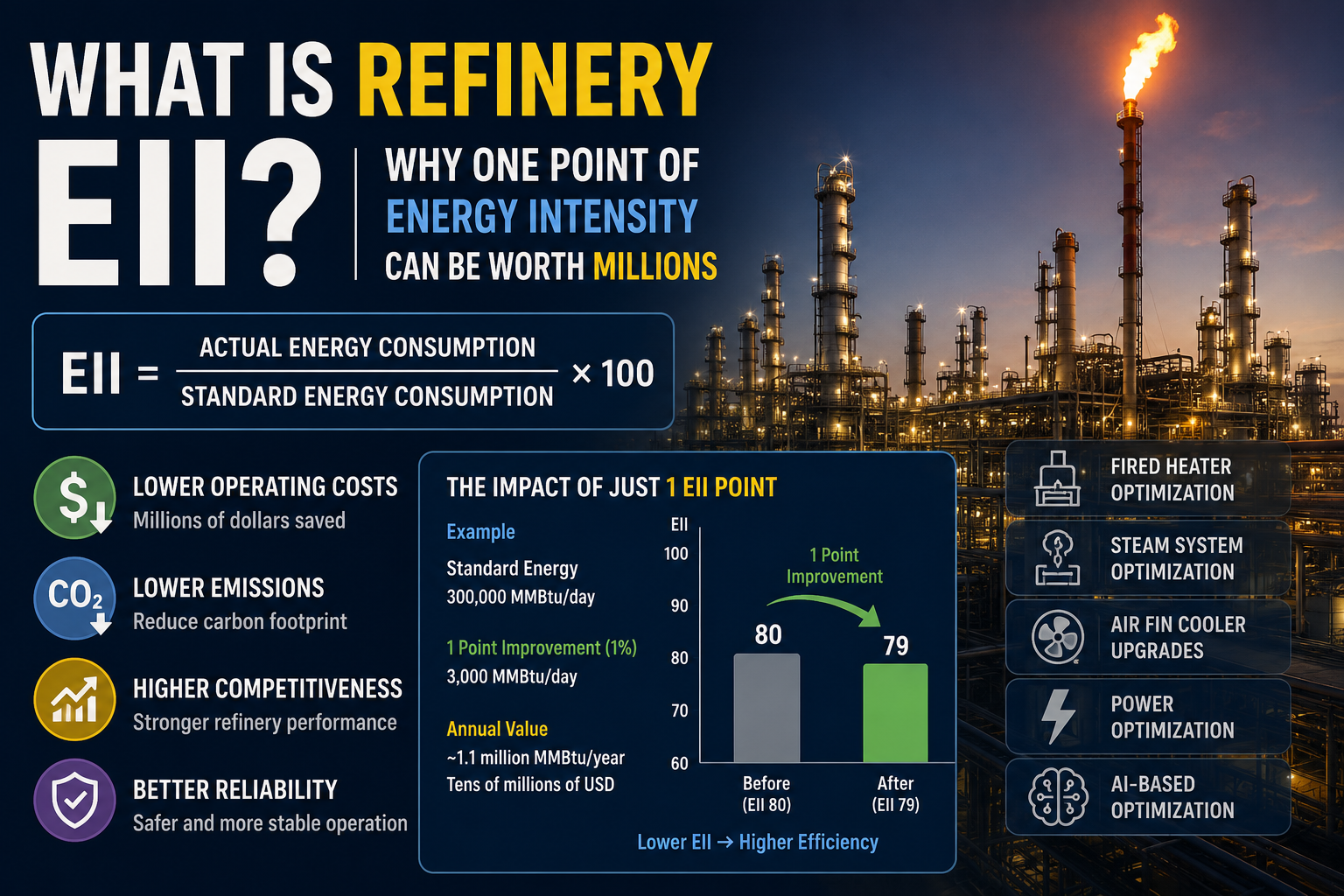
What Is EII?
The Energy Intensity Index (EII) is an industry benchmark used to evaluate how efficiently a refinery consumes energy.
Unlike simple energy consumption, EII compares a refinery's actual energy use with the energy that a reference refinery would require to process the same crude oil and produce the same product slate.
The basic concept is:
EII = Actual Energy / Standard Energy × 100
Where:
- Actual Energy = the refinery's measured energy consumption
- Standard Energy = theoretical energy required under benchmark operating conditions
An EII of 100 represents benchmark performance.
Values below 100 indicate better-than-reference energy efficiency, while higher values indicate additional opportunities for improvement.
Why Does One EII Point Matter?
At first glance, improving EII from 80 to 79 may not seem significant.
However, for a large refinery, one EII point can represent a substantial reduction in annual energy consumption.
For example:
Assume a refinery has a Standard Energy requirement of:
300,000 MMBtu/day
A one-point EII improvement represents approximately 1% of Standard Energy.
That equals:
3,000 MMBtu/day
or
1.1 million MMBtu per year.
Depending on local energy prices and the refinery's fuel mix, this can translate into tens of millions of dollars in annual operating cost savings.
That is why many refineries pursue not only one-point improvements but even 0.1-point improvements.
How Do Refineries Improve EII?
Improving EII rarely comes from one large project.
Instead, it is usually the result of many small improvements across the refinery.
Typical initiatives include:
- Fired Heater efficiency improvement
- Excess oxygen optimization
- Steam system optimization
- Heat recovery projects
- Air Fin Cooler optimization
- High-efficiency Cooling Tower Fans
- Adjustable Speed Drives (ASD)
- Process Expanders
- Combined Heat and Power (CHP)
- AI-based process optimization
Each project may contribute only a small improvement, but together they significantly reduce energy consumption.
Why Does EII Become Worse at Lower Throughput?
One common misconception is that lower refinery throughput automatically means better energy efficiency.
In reality, the opposite often happens.
Many refinery systems continue consuming energy regardless of production rate.
Examples include:
- Fired Heaters
- Steam networks
- Cooling Water systems
- Air Compressors
- Pumps
These fixed energy losses become more significant when throughput decreases.
As a result, energy consumption per barrel increases, causing EII to deteriorate.
This is one reason why many refiners also evaluate normalized energy performance when comparing operating periods.
Beyond Energy Savings
A lower EII does much more than reduce operating costs.
It also provides:
- Lower CO₂ emissions
- Better refinery competitiveness
- Improved operating reliability
- Higher ESG performance
- Stronger long-term profitability
As carbon regulations become more stringent, energy efficiency has become one of the most effective decarbonization strategies available to refineries.
The Future of Refinery Energy Management
Digital transformation is changing how refineries manage energy.
Today, many leading companies are implementing:
- Digital twins
- AI-assisted operation
- Real-time energy dashboards
- Predictive analytics
- Automated performance monitoring
The objective is no longer simply to monitor EII.
It is to predict performance before energy losses occur.
Final Thoughts
Most people never notice the amount of energy required to produce gasoline, diesel, or jet fuel.
Yet behind every barrel of refined product is a continuous effort to reduce energy consumption.
That is why refinery engineers focus on every fraction of an EII point.
Because in a modern refinery,
one point of EII is not just a number—it represents millions of dollars, lower emissions, and a stronger competitive advantage.
'Energy Management' 카테고리의 다른 글
| 정유사는 왜 Steam을 회수할까? 응축수 1톤의 숨겨진 가치 (1) | 2026.07.12 |
|---|---|
| 정유공장은 왜 24시간 불을 태울까? 수백억 원을 지키는 마지막 안전장치, Flare의 진짜 이야기 (0) | 2026.07.08 |
| 정유공장은 왜 처리량이 줄어들면 에너지 효율이 나빠질까? (0) | 2026.07.06 |
| 정유사는 왜 EII 1점에 집착할까? 숨겨진 수백억 원의 가치 (0) | 2026.07.05 |
| 정유사는 왜 알루미늄 Fan 대신 FRP Fan을 사용할까? (0) | 2026.07.04 |